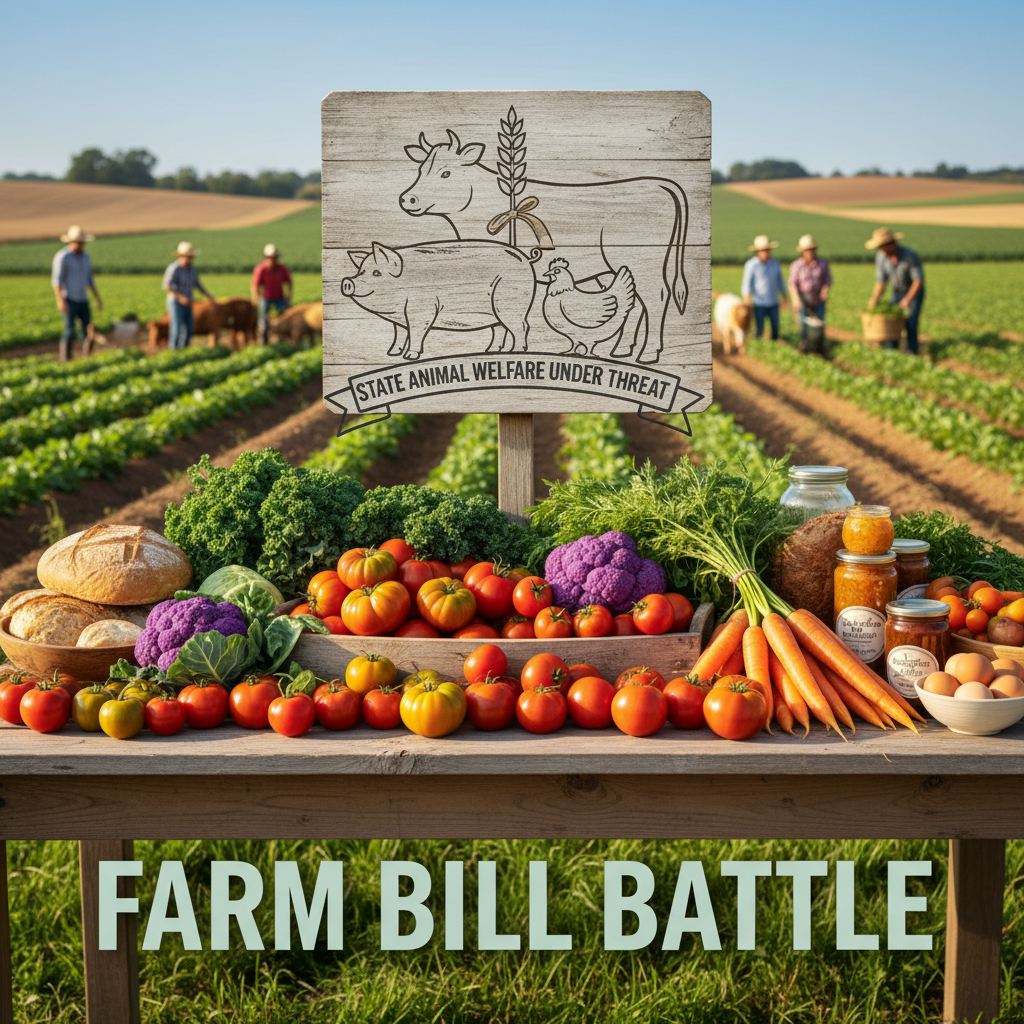
Farm Bill Battle: State Animal Welfare Under Threat
Key Takeaways
- House Farm Bill includes 'Save Our Bacon' Act overriding state animal welfare standards.
- The act would nullify state laws restricting sales of meat based on production methods.
- It targets progressive state initiatives like California's Proposition 12 for humane animal treatment.
- Senate Agriculture Committee Chair John Boozman states this language will not be in the Senate draft.
- The debate highlights a conflict between industrial agriculture and consumer demand for ethical food.
The U.S. Farm Bill, a behemoth piece of legislation shaping everything from food prices to environmental conservation, is once again at the center of a contentious debate. This time, a provision that could strip states of their right to set animal welfare standards has been approved by the House, threatening to override progressive state laws and reshape the future of ethical food production across the nation. Understanding this development is crucial for anyone concerned with the integrity of our food system.
TL;DR: Key Facts
- The 'Save Our Bacon' (SOB) Act, approved in the House farm bill, seeks to prevent states from restricting the sale of meat based on animal welfare standards.
- This act would effectively nullify existing state laws that dictate humane treatment for farm animals, such as those requiring sufficient space for breeding pigs.
- Critics argue it's an overreach of federal power, undermining states' authority to respond to their constituents' ethical and environmental concerns.
- Senate Agriculture Committee Chair John Boozman (R-Arkansas) has indicated that this language will not be included in the upcoming Senate draft of the Farm Bill.
- The debate highlights a significant clash between industrial agriculture interests and growing consumer demand for more humane and sustainable food practices.
What Happened
The U.S. House of Representatives recently passed its version of the Farm Bill, a legislative package renewed roughly every five years that directs federal agricultural and food policy. Buried within its vast provisions is a controversial measure unofficially known as the 'Save Our Bacon' (SOB) Act. This act, championed by large pork producers, is designed to prevent individual states from enacting or enforcing laws that restrict the sale of agricultural products based on the production methods used in other states. Specifically, it targets regulations concerning animal welfare standards, such as those requiring increased living space for breeding pigs.
The immediate impact of the SOB Act, if it were to become law, would be to invalidate state-level initiatives like California's Proposition 12, which mandates specific space requirements for pigs, hens, and calves whose products are sold within the state. Proponents of the SOB Act argue that such state laws create an uneven playing field for farmers, imposing costs on producers in other states who wish to sell into those markets. They advocate for a more uniform, federal standard, or a lack thereof, that prioritizes economic efficiency for large-scale operations.
However, the inclusion of the SOB Act in the House bill has met significant opposition. Senator John Boozman, the Republican Chair of the Senate Agriculture Committee, has publicly stated that his committee's forthcoming draft of the Farm Bill will not include this contentious language. This divergence between the House and Senate signals a major battle ahead as the two chambers negotiate a final version of the critical legislation, leaving the fate of state-level animal welfare regulations uncertain.
Why It Matters
This Farm Bill debate isn't just about pork; it's a critical flashpoint for the future of our food system, directly touching on the intersection of food policy, environmental ethics, and states' rights. For GreenNest Living readers, it represents a significant challenge to the growing movement for more humane and sustainable agricultural practices. If the 'Save Our Bacon' Act were to pass, it would undermine the ability of states and, by extension, their citizens, to influence how their food is produced, regardless of their values concerning animal welfare or environmental impact. This preemptive federal action risks stifling innovation in ethical farming and prioritizing industrial efficiency over public demand for more responsible practices.
Furthermore, this legislative maneuver has broader implications for environmental stewardship. Industrial-scale animal agriculture, often associated with the very practices state animal welfare laws seek to reform, is a major contributor to greenhouse gas emissions, water pollution, and land degradation. By removing states' ability to impose higher standards, the SOB Act could effectively lock in and perpetuate less sustainable, high-impact farming methods. It sets a dangerous precedent where federal power can be wielded to quash local and state-led efforts for a healthier planet and more ethical food supply, impacting not just animal welfare but also the long-term environmental health of farming communities.
Ultimately, this battle over the Farm Bill underscores the powerful influence of lobbying by big agricultural interests. It highlights the urgent need for consumers to remain engaged and vocal. Our food choices, and the policies that shape them, have profound consequences for animal well-being, the environment, and the future of sustainable living. Allowing a federal override of state-level ethical standards is a step backward for progress and consumer-driven change in the food industry.
What You Can Do
The Farm Bill process is still ongoing, and your voice matters. Here's how you can make a difference:
- Contact Your Senators: Urge them to support Senator Boozman's stance and ensure the final Farm Bill does NOT include any language resembling the 'Save Our Bacon' Act. Emphasize the importance of states' rights to set animal welfare standards.
- Support Ethical Brands: Prioritize purchasing meat and animal products from farms that visibly commit to higher animal welfare standards (e.g., certified humane, pasture-raised). Look for third-party certifications.
- Educate Yourself and Others: Understand the complexities of the Farm Bill and how it impacts your food and environment. Share this information with friends and family to build a collective voice for change.
- Advocate for Transparency: Support legislation and initiatives that require clear labeling about animal living conditions and farming practices, empowering consumers to make informed choices.
- Explore Plant-Based Options: Reducing your consumption of industrially produced meat can send a powerful market signal that ethical and environmental concerns are paramount.
Ciro's Take
As an advocate for a more sustainable and just food system, the 'Save Our Bacon' Act in the House Farm Bill is deeply troubling. It's a blatant attempt by large industrial players to centralize control and erode the democratic power of states to respond to their citizens' demands for more humane and environmentally responsible agriculture. This isn't just about how pigs are raised; it's about whether we, as consumers and citizens, have a say in the values reflected in our food supply. Allowing federal legislation to steamroll progressive state laws sets a dangerous precedent, threatening to lock us into a system that prioritizes corporate profits over animal welfare and planetary health. We must push back fiercely, reminding our elected officials that the Farm Bill should serve the public good, not merely the interests of Big Pork.
FAQs
Q: What is the U.S. Farm Bill?
A: The U.S. Farm Bill is a multi-year, omnibus piece of legislation that governs a wide range of agricultural and food programs. It is typically renewed every five years and impacts everything from crop insurance and conservation to food assistance and rural development.
Q: What exactly is the 'Save Our Bacon' (SOB) Act?
A: The 'Save Our Bacon' Act is a nickname for a provision proposed in the House Farm Bill. It aims to prohibit states from enforcing laws that restrict the sale of agricultural products (like pork) based on the animal welfare standards used to produce them in other states, essentially overriding state-specific humane farming laws.
Q: What does 'states' authority to restrict sales' mean in this context?
A: It refers to a state's right to pass laws that regulate the sale of products within its borders, even if those products are produced elsewhere. In this case, states like California have passed laws requiring certain animal welfare standards (e.g., space for breeding pigs) for products sold to their residents, regardless of where the animals were raised.
Sources
This article is based on reporting by Civil Eats.
Original source
Civil Eats
Author, Digital Entrepreneur & AI Creator
More from Food & Environment
- From Blight to Bounty: A Regenerative Farm's Community Lifeline — May 30, 2026
- FDA Highest Risk: Seasoning Recalls Expand, What to Know — May 28, 2026
- Climate Change Fuels Malaria Surge: A Wake-Up Call for Global Health — May 27, 2026
- Salmon, Culture, & Conservation: Voices from San Juan Islands — May 26, 2026