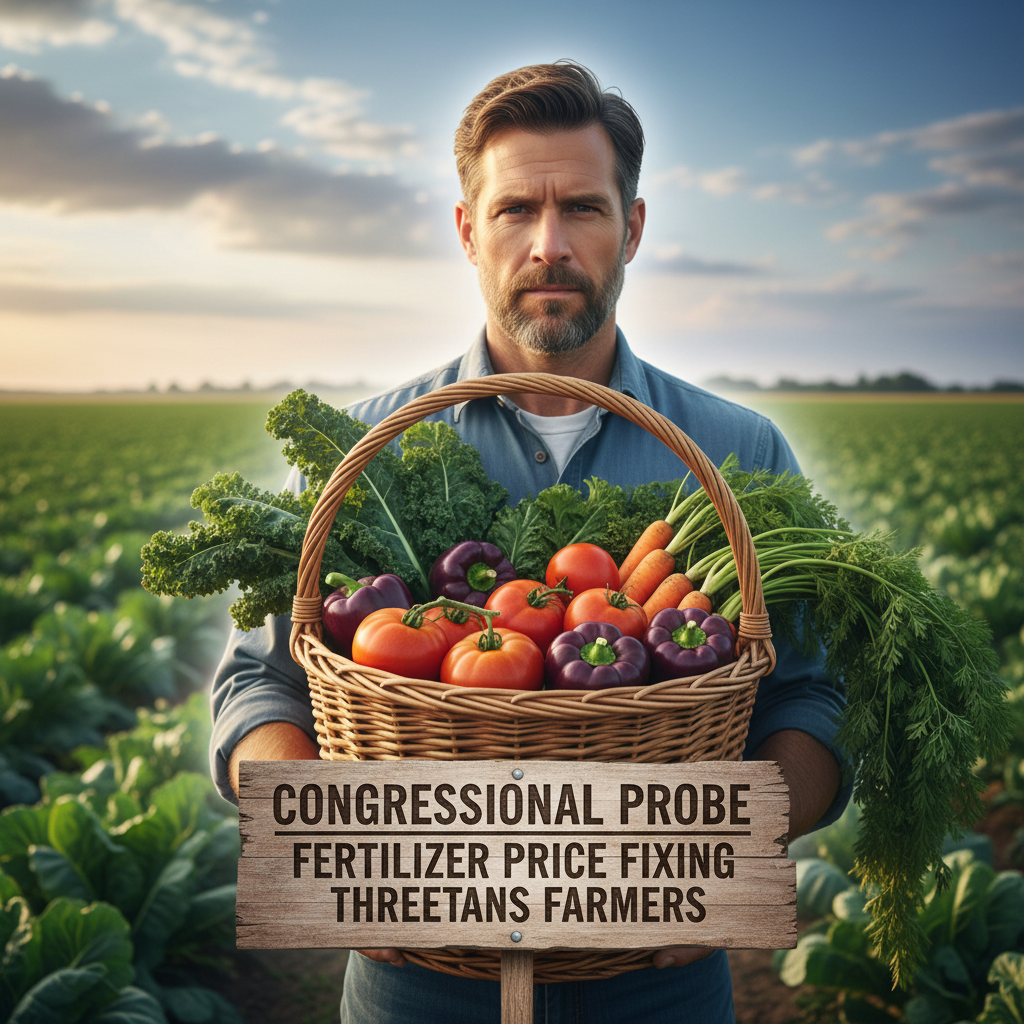
Congressional Probe: Fertilizer Price Fixing Threatens Farmers
Key Takeaways
- Congressional probe launched into fertilizer price fixing.
- Rising fertilizer costs linked to global events like the Iran war.
- Bipartisan effort aims to address farmers' economic hardships.
- Investigation scrutinizes market fairness and corporate power in agriculture.
- Impacts food prices, farm sustainability, and food system resilience.
Congressional Probe: Fertilizer Price Fixing Threatens Farmers
The stability of our food system is under a microscope as Congress launches a bipartisan investigation into alleged price fixing by major fertilizer companies. With global events like the Iran war driving up essential agricultural costs, this scrutiny couldn't come at a more critical time for farmers, consumers, and the environmental health of our planet.
This investigation highlights fundamental challenges within our food supply chain, emphasizing how corporate practices can directly impact everything from a farmer's livelihood to the price of groceries in your local supermarket. It's a stark reminder that what happens behind closed boardroom doors has far-reaching consequences for all of us.
TL;DR: Key Facts
- Fertilizer companies are facing congressional scrutiny over potential price-fixing allegations.
- This investigation is a bipartisan effort led by senators like John Thune (R-South Dakota).
- The inquiry comes as fertilizer prices have soared, partly due to global conflicts such as the Iran war.
- Lawmakers aim to address the significant economic hardships faced by farmers due to these rising costs.
- Federal agencies are also turning their attention to potential anti-competitive practices in the fertilizer market.
What Happened
As farmers across the nation grapple with unprecedented economic pressures, a spotlight has been turned onto the essential yet increasingly costly input: fertilizer. On March 18, 2026, a significant development unfolded as lawmakers initiated a bipartisan investigation into the practices of major fertilizer companies. This congressional scrutiny, spearheaded by figures such as Senate Majority Leader John Thune (R-South Dakota) and others, aims to uncover whether these powerful corporations have engaged in price-fixing amid a period of dramatic price hikes.
The backdrop for this inquiry is a turbulent global landscape, with the ongoing war in Iran explicitly cited as a contributing factor to the soaring cost of fertilizers. This geopolitical instability has ripple effects that reach directly into America's farmlands, exacerbating existing challenges for agricultural producers. Faced with farmers' mounting economic woes, Congress and federal agencies are now meticulously examining the market dynamics, scrutinizing the possibility of anti-competitive behavior that could be unfairly inflating prices and squeezing already tight margins for agricultural businesses.
The motivation behind this concerted effort is clear: to ensure fairness in critical agricultural markets and to protect the economic viability of American farming. The allegations suggest that, rather than solely being a product of supply and demand or geopolitical tensions, some of the price increases might be the result of coordinated, illicit practices by companies controlling a vital input for food production. This investigation is a crucial step towards understanding and potentially rectifying systemic issues within the agricultural supply chain that directly impact our nation’s food security and the sustainability of farming livelihoods.
Why It Matters
This congressional investigation into fertilizer price fixing isn't just about corporate malfeasance; it's a critical moment for the future of our food and environment. For GreenNest Living readers, understanding this issue is paramount because the cost of fertilizer directly impacts the food on your plate, the financial health of the farmers who grow it, and the ecological footprint of our agricultural system. When fertilizer prices soar, farmers face immense pressure. They may be forced to cut back on other essential investments, delay crucial planting, or even go out of business, leading to less resilient local food systems and potentially higher prices for consumers. This economic strain can also push some towards less sustainable, short-term solutions to maintain yields, further stressing the environment.
From an environmental perspective, the implications are profound. High fertilizer costs, especially if manipulated, undermine efforts towards sustainable agriculture. Farmers who are struggling financially are less likely to invest in expensive, long-term sustainable practices like regenerative agriculture, cover cropping, or precision farming, which can reduce reliance on synthetic inputs. Instead, they might feel compelled to maximize output with existing methods, which often involves heavy use of synthetic fertilizers with known environmental consequences, such as nitrogen runoff polluting waterways and contributing to greenhouse gas emissions. This investigation serves as a stark reminder that economic fairness in the agricultural supply chain is intrinsically linked to our environmental goals and the health of our ecosystems.
Ultimately, this inquiry into potential price fixing underscores the immense power wielded by a few large corporations over foundational aspects of our food system. It's a call for transparency and accountability that directly relates to food security, the viability of small and medium-sized farms, and the broader transition towards a more sustainable and equitable agricultural future. As conscious consumers and environmental advocates, understanding these systemic challenges allows us to advocate for policies and practices that support both the planet and the people who feed us.
What You Can Do
- Support Policy Advocacy: Contact your elected officials to express your concern about fair pricing in agricultural inputs and support policies that promote competitive markets and anti-trust enforcement.
- Champion Regenerative Agriculture: Learn about and advocate for farming practices that reduce reliance on synthetic fertilizers, such as regenerative agriculture, composting, and cover cropping, which enhance soil health naturally.
- Buy Directly from Farmers: Support local farmers and CSAs (Community Supported Agriculture). This helps them retain more of their income, making them less vulnerable to volatile input costs.
- Educate Yourself: Stay informed about the complexities of our food supply chain, from farm inputs to market prices. Understanding these connections empowers you to make more informed choices.
- Reduce Food Waste: Minimizing food waste lessens the overall demand on the food system, indirectly reducing the pressure for high-input, intensive farming practices.
- Invest in Local Soil Health Initiatives: Support local organizations working on soil health and sustainable farming techniques, which can provide farmers with alternatives to expensive synthetic fertilizers.
FAQs
Q: What is price fixing in this context?
A: Price fixing occurs when competitors illegally agree to raise, lower, or stabilize prices. In the fertilizer industry, this would mean companies colluding to keep prices artificially high, harming farmers who rely on these essential inputs.
Q: How do rising fertilizer prices ultimately affect me, the consumer?
A: Higher fertilizer prices directly increase farming costs, which are then often passed on to consumers through higher food prices. It can also lead to reduced agricultural output if farmers cut back, potentially impacting food availability and variety.
Q: What are the environmental concerns related to synthetic fertilizers?
A: Over-reliance on synthetic fertilizers can lead to environmental issues such as nutrient runoff into waterways, causing eutrophication and dead zones; greenhouse gas emissions (especially nitrous oxide, a potent GHG); and long-term soil degradation, reducing biodiversity and fertility.
Sources
This article is based on reporting by Food Tank.
Original source
Food Tank
Author, Digital Entrepreneur & AI Creator
More from Food & Environment
- Gardening: A Neurosurgeon's Secret to Longevity & Well-being — May 13, 2026
- Farm to School: Nourishing Kids, Cultivating Community Growth — May 12, 2026
- High-Risk Cheese Outbreak: FDA Alert Amid E. coli Fears — May 11, 2026
- Are Your 'Healthy' Foods Truly Nutritious? New Study Investigates — May 10, 2026
- Australia Battles Food Waste: A Global Sustainability Push — May 9, 2026