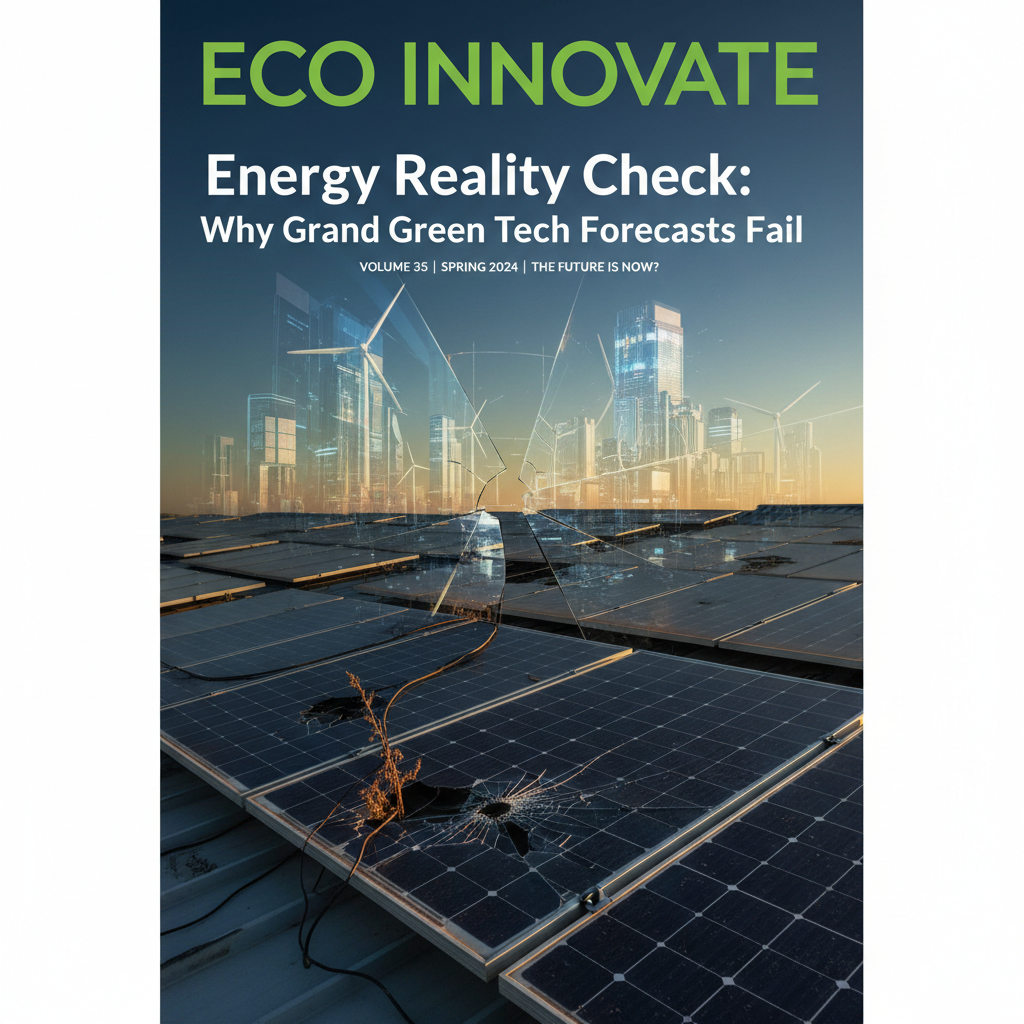
Energy Reality Check: Why Grand Green Tech Forecasts Fail
Key Takeaways
- Energy forecasts for nuclear and hydrogen consistently overestimate growth.
- Technical potential often overshadows real-world social and political complexities.
- Grid models frequently miss these crucial non-technical factors.
- Over-optimism leads to misallocated resources and slowed decarbonization.
- A more realistic, multidisciplinary approach to energy planning is urgently needed.
Unmasking the Energy Transition: Why Our Predictions Miss the Mark
As the global push for sustainable energy intensifies, many look to promising technologies like nuclear and hydrogen with high hopes. However, a recent analysis brings a sobering reality check, revealing a persistent gap between ambitious forecasts and the on-the-ground challenges of implementation. This isn't just about technical hurdles; it's about deeply ingrained issues in how we imagine and plan our green future, urging us to question the narratives shaping our energy transition right now.
TL;DR: Key Facts
- Energy forecasts for technologies like nuclear power and hydrogen consistently overestimate growth and speed of deployment.
- The discrepancy stems from an overreliance on technical potential while underestimating real-world complexities like social acceptance, political will, and market dynamics.
- Current grid models often fail to account for these 'messy' realities, leading to unrealistic projections.
- A recent Energy Research & Social Science paper highlights this consistent pattern of over-optimism.
- The gap between imagination and reality can lead to misallocated resources and slowed progress in decarbonization.
What Happened
A recent paper published in Energy Research & Social Science has brought to light a significant and recurring problem in the energy sector: the consistent overestimation of growth and deployment rates for certain key technologies, particularly nuclear power and hydrogen. The study points out that forecasts for these energy sources have repeatedly predicted faster, cheaper, and broader adoption than has actually materialized.
This isn't a new phenomenon, but rather a persistent pattern observed across decades. The paper suggests that these 'imaginaries' or optimistic projections often rely heavily on the technical feasibility of a solution, while largely overlooking the complex social, political, economic, and logistical realities that dictate real-world implementation. Furthermore, existing grid reality models often miss these crucial non-technical factors, leading to a disconnect between theoretical potential and actual grid integration challenges.
Why It Matters
For GreenNest Living readers, this isn't just an academic critique; it's a critical lens through which to evaluate the future of sustainable living and the integrity of our global energy transition efforts. When forecasts consistently miss the mark, it leads to a cascade of negative consequences: misallocation of public and private funds, misplaced policy priorities, and ultimately, a slower pace of decarbonization. If we're constantly planning for a future that doesn't materialize as imagined, we risk wasting precious resources and time, which are luxuries we cannot afford in the face of climate change.
This insight underscores a fundamental truth in Green Tech: innovation alone isn't enough. The success of sustainable solutions hinges equally on their social acceptance, regulatory frameworks, economic viability, and the complex interplay of human behavior and institutional inertia. A realistic understanding of these 'messy' factors is paramount. Without it, we risk repeating past mistakes, chasing technological unicorns while neglecting practical, implementable solutions that can make a real difference today. It challenges us to move beyond aspirational rhetoric and demand grounded, evidence-based strategies for our energy future, ensuring that our green dreams are built on solid ground, not just imagination.
What You Can Do
Here are practical steps you can take to foster a more realistic and effective energy transition:
- Question the Hype: When you hear grand pronouncements about a single 'silver bullet' energy solution, apply critical thinking. Research the real-world challenges of deployment, not just the technical potential.
- Advocate for Holistic Planning: Support policies and leaders who emphasize integrated energy planning, considering not only technology but also social equity, community engagement, and infrastructure resilience.
- Diversify Your Energy Knowledge: Learn about a range of renewable technologies, from utility-scale wind and solar to distributed rooftop solar and local microgrids. Understand their pros, cons, and realistic deployment timelines.
- Engage Locally: Participate in local energy planning initiatives. Your input on community needs, land use, and local grid capabilities can help ground grand visions in practical reality.
- Support Realistic Funding: Encourage investment in proven, scalable clean energy solutions that can be deployed now, while also supporting R&D for next-generation technologies with a clear understanding of their long development cycles.
Ciro's Take
As an environmental advocate, reading about the persistent gap between energy forecasts and reality stirs a familiar frustration. It reminds me how often we, as a society, get caught up in the allure of the next big thing, pouring resources into 'moonshot' technologies without fully acknowledging the intricate web of human, political, and logistical challenges that define real-world implementation. This isn't to say we shouldn't innovate or dream big, but rather, we must temper our enthusiasm with a rigorous commitment to practicality and transparency.
For me, the lesson is clear: true progress in Green Tech isn't about finding a magic bullet; it's about methodically addressing the complexities of our existing systems and integrating diverse, proven solutions with a deep understanding of community needs. We need less marketing sizzle and more genuine, grounded engineering and social science. Our planet deserves a future built on realism, not just wishful thinking.
FAQs
Q: Why do energy forecasts consistently miss the mark?
A: Forecasts often suffer from over-optimism, focusing too much on technical potential and underestimating the 'messy' real-world factors like social acceptance, regulatory hurdles, political opposition, supply chain issues, and the sheer cost and time required for massive infrastructure build-outs.
Q: Does this mean nuclear power and hydrogen aren't viable green energy solutions?
A: Not necessarily. It means their path to widespread adoption is more complex and slower than often projected. They may still play a role in the energy transition, but their contribution needs to be assessed with a greater degree of realism, accounting for their unique challenges and costs.
Q: How can we create more accurate energy forecasts?
A: More accurate forecasts require a multidisciplinary approach, integrating insights from engineering, economics, social sciences, and policy studies. They need to account for non-technical barriers, learn from historical patterns of deployment, and involve diverse stakeholders to ensure a more grounded understanding of reality.
Sources
This article is based on reporting by CleanTechnica.
Original source
CleanTechnica
Author, Digital Entrepreneur & AI Creator
More from Green Tech
- Ontario's Grid Puzzle: Hydrostor vs. BESS Reality Check — May 20, 2026
- F1's Carbon U-Turn? Ford's V-8 Engine Plans Raise Eyebrows — May 19, 2026
- Colorado River Crisis Deepens: West Faces Historic Water Cuts — May 18, 2026
- EPA Rolls Back Toxic Waste Rules, Threatening Iowa Waterways — May 16, 2026