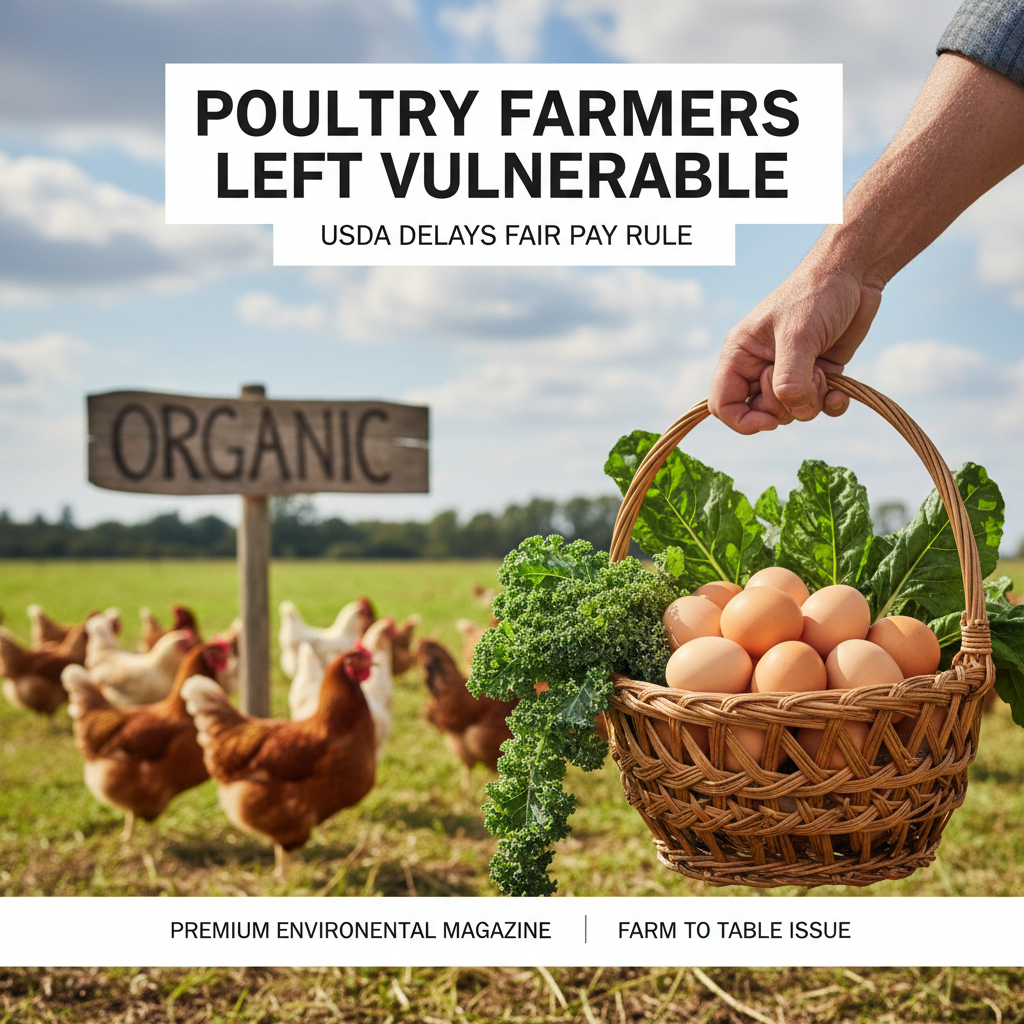
Poultry Farmers Left Vulnerable: USDA Delays Fair Pay Rule
Key Takeaways
- USDA delayed a rule protecting poultry farmers.
- Rule targets unfair payment practices in the 'tournament system'.
- Delay is until June 1, 2026, despite significant public opposition.
- This impacts farmer livelihoods and ethical food production.
- The decision sparks concerns about corporate power in agriculture.
The promise of a fair and sustainable food system often hinges on policies designed to protect its most vulnerable links: our farmers. A recent decision by the U.S. Department of Agriculture (USDA) to delay a critical rule intended to safeguard contract poultry farmers from unfair payment practices has sent ripples of concern through the sustainable living community, threatening the economic stability of countless families and the integrity of our food supply.
TL;DR: Key Facts
- The USDA postponed a rule designed to protect contract poultry farmers.
- The delay specifically targets regulations on unfair payment practices within the chicken industry's controversial “tournament system.”
- Despite thousands of public comments in opposition, the new implementation date for the rule is now June 1, 2026.
- This decision prolongs existing vulnerabilities for farmers and reinforces power imbalances within the agricultural supply chain.
- The regulations were part of a broader suite aimed at ensuring fairer and more transparent agricultural markets.
What Happened
In a move that has drawn significant criticism, the U.S. Department of Agriculture (USDA) finalized a decision to delay the implementation of tighter regulations aimed at protecting contract poultry farmers. These regulations were designed to address long-standing issues concerning how farmers are paid under the chicken industry's controversial “tournament system.” Originally intended to provide much-needed safeguards, the rule's enforcement has now been pushed back to June 1, 2026.
This delay comes despite thousands of public comments opposing such a postponement, underscoring a deep divide between farmer advocates and industry interests. The regulations are part of a broader effort to reform payment practices within the poultry sector, where farmers often face opaque and potentially exploitative contracts with large processing companies. The tournament system, in particular, has been a flashpoint for debate due to its inherent risks to farmer income and financial stability.
By postponing these crucial protections, the USDA's decision effectively leaves contract poultry farmers exposed to existing unfair practices for another two years. This move raises questions about the agency's commitment to supporting farmer livelihoods and fostering a more equitable and transparent food system, especially for those operating at the front lines of food production.
Why It Matters
For GreenNest Living readers, this isn't just about regulatory red tape; it's about the very foundation of ethical and sustainable food. The delay in protecting poultry farmers from unfair payment practices has profound implications for both individual livelihoods and the broader 'Food & Environment' landscape. When farmers are subject to exploitative economic conditions, their ability to invest in sustainable land management, animal welfare improvements, and long-term environmental stewardship is severely compromised. Financial insecurity often forces producers to prioritize short-term gains over ecological health, leading to practices that can degrade soil, contaminate water, and reduce biodiversity on farmlands.
Moreover, this issue highlights the pervasive power imbalance within our food system. A few large processing companies often dictate terms to numerous contract farmers, leaving little room for negotiation or recourse. This dynamic not only harms individual farmers but also stifles innovation and diversification in agriculture, pushing towards industrial models that may not align with regenerative or environmentally conscious practices. For consumers who strive to support ethical food, understanding these systemic vulnerabilities is crucial, as the true cost of cheap chicken is often borne by the farmers and the environment.
Ultimately, a fair and transparent payment system for farmers is a cornerstone of a truly sustainable food economy. Without it, the rhetoric of 'sustainability' rings hollow. When farmers can't make a living wage, the entire system is unstable. This USDA delay signals a step backward in the journey towards a food system that values both people and planet, making it harder for conscientious consumers to find and support truly ethical poultry.
What You Can Do
- Educate Yourself: Learn more about the “tournament system” in poultry farming and its pervasive impact on farmers' economic stability.
- Seek Transparency: Look for chicken products that clearly state their sourcing, farming practices, and farmer payment models. Prioritize supporting brands known for fair trade and farmer-friendly practices.
- Support Independent Farmers: Whenever possible, buy poultry directly from local, independent farmers at farmers' markets or through Community Supported Agriculture (CSA) programs who can attest to their ethical payment practices.
- Advocate for Policy Change: Contact your elected representatives and the USDA to express your concern about the delayed rule and advocate for stronger, swifter protections for contract farmers.
- Consider Plant-Based Options: Explore reducing your reliance on conventionally raised meat by incorporating more plant-based meals into your diet, which lessens demand on problematic industrial systems.
- Engage with Organizations: Support non-profits and advocacy groups working to create more equitable and sustainable food systems for all, including farmer welfare.
Ciro's Take
As someone deeply invested in the health of our planet and the well-being of its people, news like this hits hard. It's frustrating to see crucial protections for independent farmers, the backbone of our food system, pushed aside for what feels like corporate convenience. This isn't just about chicken; it's about justice. When farmers are economically squeezed, it’s not just their families who suffer; it’s the land they tend, the animals they raise, and ultimately, the food we eat. We often talk about 'voting with our forks,' but true change also requires us to stand up for policy that creates a level playing field. This delay is a stark reminder that the fight for a truly sustainable and ethical food future is ongoing, and it demands our unwavering attention and advocacy.
FAQs
Q: What is the "tournament system" in poultry farming?
A: The "tournament system" is a payment structure where contract farmers are paid based on how efficiently their flock converts feed into meat, relative to other farmers in the same batch or "tournament." This system is often criticized for being opaque, creating unfair competition, and shifting significant financial risk onto the farmers.
Q: Why did the USDA delay this protective rule?
A: While the USDA has not explicitly detailed its reasons for the delay beyond the finalization of the rule, such postponements often result from intense lobbying efforts from powerful industry groups, arguing for less regulatory burden, despite strong opposition from farmer advocacy groups.
Q: How does this impact consumers who buy chicken?
A: Directly, the delay might not immediately impact retail chicken prices or availability. However, it perpetuates a system where the true costs of production, including farmer exploitation and potential environmental shortcuts driven by financial pressure, are externalized. Consumers seeking ethically produced chicken may find it harder to ensure their purchases support fair practices.
Sources
This article is based on reporting by Food Tank.
Original source
Food Tank
Author, Digital Entrepreneur & AI Creator
More from Food & Environment
- Ocean's Untapped Riches: Iceland Pioneers Zero-Waste Seafood — June 3, 2026
- Trump Era: Local Food Systems & Small Farms Face Headwinds — June 1, 2026
- Clean Plate Movement: States Ban Dyes, World Shifts from Processed Foods — May 31, 2026
- From Blight to Bounty: A Regenerative Farm's Community Lifeline — May 30, 2026