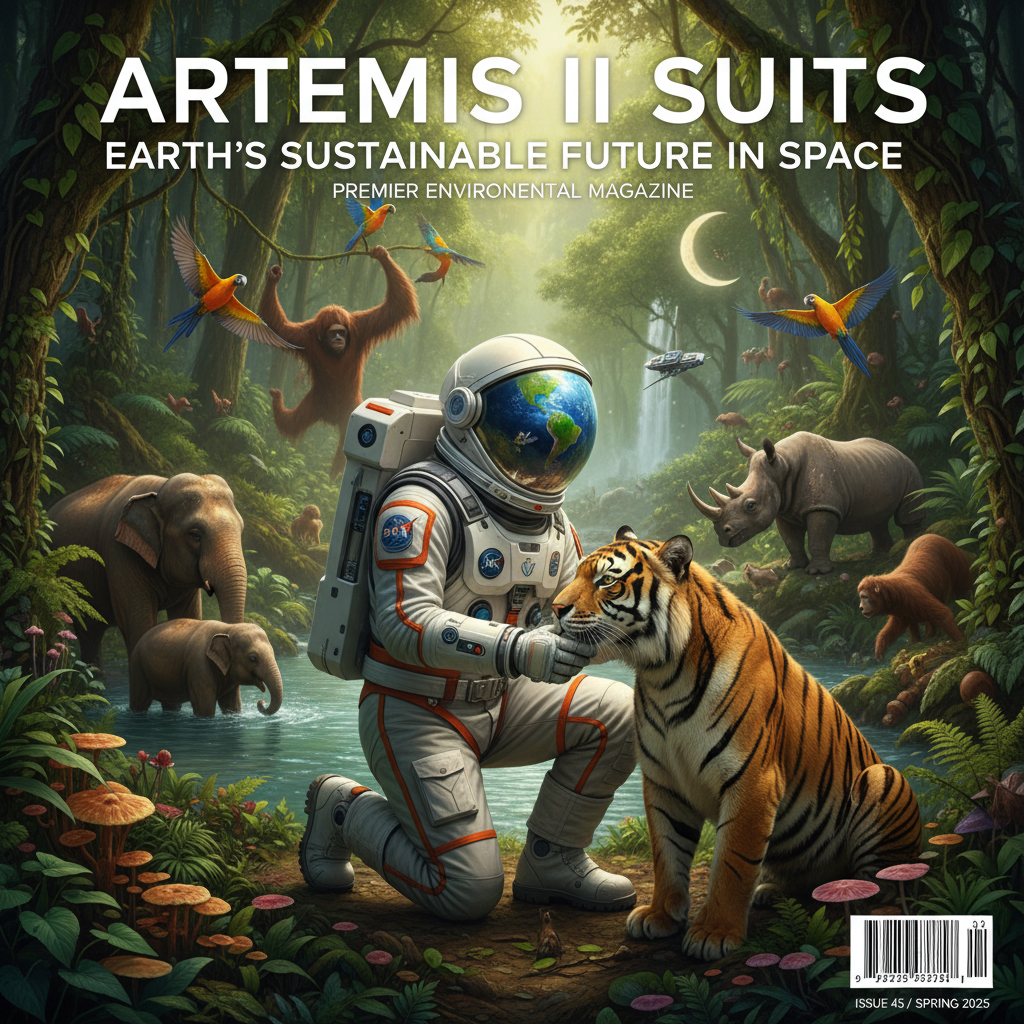
Artemis II Suits: Earth's Sustainable Future in Space
Key Takeaways
- Artemis II crew's Orion Crew Survival System (OCSS) suits unveiled.
- Suits are vital for crew safety during critical lunar mission phases.
- Space missions inspire environmental awareness through the 'Overview Effect'.
- Advanced materials and closed-loop systems in space suits offer potential for sustainable applications on Earth.
- Technological spin-offs from space exploration can drive Earth-focused environmental solutions.
As humanity stands on the cusp of returning to the Moon with the Artemis II mission, the unveiling of the crew's Orion Crew Survival System (OCSS) suits isn't just a technological marvel – it's a profound moment for reflection on our planet's future. These highly advanced garments, designed for the most extreme environments, embody a level of material science and engineering ingenuity that holds crucial lessons for sustainable living right here on Earth.
For GreenNest Living readers, this isn't just about space travel; it's about how the pursuit of the extraordinary can inspire and inform our commitment to environmental stewardship and the circular economy.
TL;DR: Key Facts
- The Orion Crew Survival System (OCSS) suits for the Artemis II mission have been revealed.
- The crew includes Commander Reid Wiseman, Pilot Victor Glover, and Mission Specialist Christina Koch (NASA), and Mission Specialist Jeremy Hansen (CSA).
- These suits are critical for crew safety during launch, re-entry, and potential in-flight emergencies.
- The reveal took place in the suit-up room of the Neil A. Armstrong Operations and Checkout Building.
- Artemis II will be the first crewed test flight of NASA's Orion spacecraft around the Moon.
What Happened
The highly anticipated Artemis II mission recently showcased a vital piece of equipment: the Orion Crew Survival System (OCSS) suits. These state-of-the-art garments are far more than just uniforms; they are comprehensive life support systems designed to protect the four-person international crew during critical phases of their journey to orbit the Moon. Commander Reid Wiseman, Pilot Victor Glover, and Mission Specialist Christina Koch from NASA, alongside Mission Specialist Jeremy Hansen from the Canadian Space Agency (CSA), will rely on these meticulously engineered suits for their safety and survival.
The suits were observed in the suit-up room of the Neil A. Armstrong Operations and Checkout Building, a hallowed ground for astronaut preparations. Each suit is custom-fitted and packed with advanced technologies to ensure the crew can operate effectively and safely throughout the demanding test flight. From regulating body temperature and pressure to providing communication capabilities and critical supplies, these OCSS suits represent the pinnacle of aerospace textile and life-support engineering, a testament to decades of scientific advancement and international collaboration aimed at pushing the boundaries of human exploration.
Why It Matters
At GreenNest Living, we understand that true sustainability encompasses not just our immediate surroundings, but also how we envision and execute humanity's grandest ambitions. The Artemis II mission, and specifically the development of these advanced OCSS suits, offers a compelling lens through which to examine our commitment to environmental responsibility and innovation.
Firstly, the very act of venturing into space, enabled by technologies like these suits, provides an invaluable perspective—the 'Overview Effect.' Astronauts consistently report a profound shift in consciousness upon seeing Earth as a fragile, vibrant blue marble amidst the vast emptiness. This perspective often ignites a deeper commitment to protecting our planet, reminding us that its resources are finite and its ecosystems interconnected. The suits, in enabling this journey, indirectly foster a heightened global environmental awareness that can inspire collective action.
Secondly, the materials science and engineering required for these suits are phenomenal. Designed to withstand extreme temperatures, radiation, and mechanical stress, they employ lightweight, durable, and highly functional textiles. The pursuit of such advanced, resilient materials for space exploration offers immense potential for technological spin-offs on Earth. Imagine if the principles behind these suits—longevity, high performance, and closed-loop functionality for life support—were universally applied to our everyday products, from clothing to construction materials. This could revolutionize industries, driving a shift towards truly circular economies where products are designed for durability, repair, and ultimate recyclability, dramatically reducing waste and resource consumption.
Ultimately, these space suits are a symbol of human ingenuity in the face of daunting challenges. The rigorous demands of space push engineers to innovate sustainable solutions for resource management, energy efficiency, and waste reduction within a closed system. These learnings are directly applicable to Earth, where we face similar, albeit less extreme, challenges. By observing and advocating for responsible and innovative practices in space exploration, we can champion a future where technological progress and environmental stewardship are not mutually exclusive, but rather intrinsically linked for the benefit of all life on Earth.
What You Can Do
- Support Sustainable Innovation: Seek out and support brands and companies that are investing in cutting-edge material science, durability, and circular design principles in their products. Look for certifications that demonstrate a commitment to environmental performance.
- Embrace the Circular Economy: Extend the life of your own items by repairing, reusing, and recycling. Consider buying second-hand or upcycled goods to reduce demand for new production and minimize waste.
- Learn About Space-for-Earth Benefits: Educate yourself on how space technologies, including advanced sensors and satellite systems, contribute to environmental monitoring, climate science, and disaster relief on Earth. Share this knowledge to highlight the practical value of space exploration.
- Advocate for Responsible Resource Management: Push for policies that encourage sustainable material sourcing, responsible manufacturing processes, and extended producer responsibility, inspired by the closed-loop systems developed for extreme environments.
- Reconnect with Nature: Take inspiration from the astronauts’ view of Earth's beauty. Spend time in natural environments to foster a deeper personal connection and appreciation for the ecosystems we are striving to protect.
- Reduce Your Material Footprint: Be a conscious consumer. Before purchasing, consider the true need for an item, its lifecycle, and its potential environmental impact. Choose quality, versatile items that will last, mirroring the longevity required for space-grade equipment.
FAQs
Q: What are the Orion Crew Survival System suits for?
A: The OCSS suits are advanced survival systems designed to protect the Artemis II crew during launch, re-entry, and potential in-flight emergencies, providing critical life support in extreme conditions.
Q: How do space missions relate to environmental sustainability?
A: Space missions, by enabling a view of Earth from afar, often inspire environmental stewardship (the 'Overview Effect'). They also drive innovation in materials science, closed-loop systems, and resource management that can have direct applications for sustainability on Earth.
Q: Can technologies from space suits benefit Earth?
A: Absolutely. The advanced, durable, and lightweight materials, as well as the life-support systems developed for space suits, can inspire and inform sustainable practices in fields like textile manufacturing, waste reduction, and circular economy design.
Sources
This article is based on reporting by NASA Image of the Day.
Original source
NASA Image of the Day
Author, Digital Entrepreneur & AI Creator
More from Wildlife & Nature News
- The Silent Drain: Sand Scarcity Threatens Global Ecosystems — May 13, 2026
- Celestial Glimpse: Earth's Glow, Our Lost Night Skies — May 11, 2026
- Google's UK Datacentre Emissions Understated by Factor of Five — May 10, 2026
- Cosmic Beacon: Earth's Glow Inspires Global Stewardship — May 9, 2026
- Amazon Tipping Point: Deforestation, Warming Threaten Rainforest by 2040s — May 8, 2026