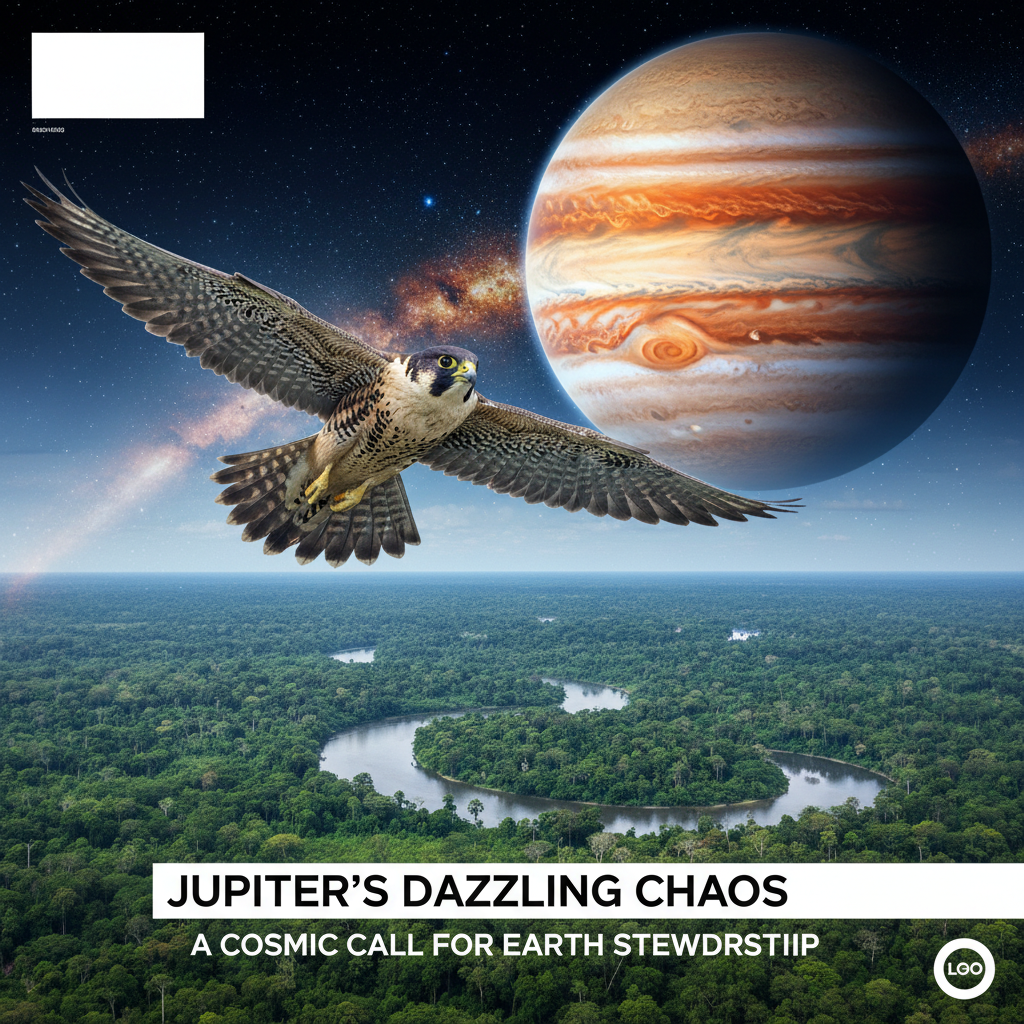
Jupiter's Dazzling Chaos: A Cosmic Call for Earth Stewardship
Key Takeaways
- NASA's Juno spacecraft captured vibrant, color-enhanced views of Jupiter's northern hemisphere on May 12, 2024.
- The images reveal complex and turbulent atmospheric patterns on the gas giant.
- This cosmic perspective highlights the uniqueness and preciousness of Earth as a life-sustaining planet.
- Space exploration, like the Juno mission, provides data and inspiration crucial for understanding and protecting our home planet.
- It reinforces the call for environmental stewardship and sustainable living practices on Earth.
In an era where our planet faces unprecedented environmental challenges, gazing beyond our atmosphere often provides the clearest perspective on our home's fragility. The latest breathtaking images from NASA's Juno spacecraft, revealing Jupiter's chaotic yet mesmerizing northern hemisphere, offer just such a moment of cosmic reflection. These vibrant, swirling vistas remind us not only of the universe's boundless wonders but also underscore the unique, life-sustaining beauty of Earth that we are called to protect.
TL;DR: Key Facts
- NASA's Juno spacecraft performed its 61st close flyby of Jupiter on May 12, 2024.
- The mission captured a color-enhanced view of the gas giant's northern hemisphere.
- The images reveal intricate, vibrant patterns within Jupiter's turbulent atmosphere.
- This data continues to provide insights into Jupiter's structure, dynamics, and composition.
What Happened
On May 12, 2024, NASA's robotic emissary, the Juno spacecraft, completed its 61st close flyby of Jupiter, continuing its extended mission to probe the secrets of our solar system's largest planet. During this orbital pass, Juno's sophisticated instruments, including its JunoCam imager, captured a series of spectacular observations. These raw data sets were then processed and color-enhanced by citizen scientists, bringing forth an astonishing visual representation of Jupiter's complex atmospheric phenomena.
The resulting images, shared as NASA's Image of the Day, showcase the vibrant and tumultuous beauty of Jupiter's northern hemisphere. Swirling clouds of various chemical compositions appear as intricate bands, eddies, and storms, painted in rich oranges, blues, and whites. These color enhancements help scientists and the public alike discern the subtle yet dramatic differences in altitude and composition of Jupiter's cloud layers, revealing a chaotic yet strangely organized cosmic ballet occurring hundreds of millions of miles from Earth.
Why It Matters
For readers of GreenNest Living, the sight of Jupiter's alien beauty might seem far removed from our usual focus on terrestrial wildlife and natural ecosystems. However, this distant celestial marvel serves as a powerful reminder of Earth's unparalleled preciousness. Jupiter, a gas giant with no solid surface and an atmosphere hostile to life as we know it, starkly contrasts with our verdant, blue planet. When we witness the incredible, yet uninhabitable, dynamism of Jupiter, it sharpens our appreciation for Earth's delicate balance of conditions that allow for biodiversity to flourish.
This cosmic perspective inspires a deeper sense of stewardship. Understanding the vast, often hostile, expanse of space helps us recognize that Earth is not merely a planet among many, but a singular oasis of life. The very act of observing and studying such distant worlds through missions like Juno reinforces the scientific endeavor that not only broadens our understanding of the universe but also equips us with tools and knowledge crucial for understanding and protecting our own planetary systems, from atmospheric science to climate modeling. This connection between space exploration and Earth conservation is more direct than it often appears, with satellite technologies born from planetary missions now vital for monitoring our climate, ecosystems, and wildlife from above.
Ultimately, these images are a call to wonder, a fundamental human emotion that underpins our desire to protect what is beautiful and unique. The vibrant chaos of Jupiter, while magnificent, is a silent testament to the extraordinary nature of our serene, life-filled home. It urges us to cherish and safeguard the intricate, living systems that make Earth the truly colorful and chaotic wonder within our cosmic neighborhood.
What You Can Do
Inspired by the wonders of the cosmos and the uniqueness of Earth, here's how you can make a difference:
- Embrace Local Nature: Spend time outdoors, whether in a national park, a local green space, or even your backyard. Reconnect with the vibrant ecosystems around you to foster a deeper appreciation for Earth's living systems.
- Support Environmental Science: Advocate for funding and policies that support Earth observation missions, climate research, and biodiversity studies. Understanding our planet is the first step toward protecting it.
- Reduce Your Footprint: Adopt sustainable practices in your daily life – conserve energy, reduce waste, choose sustainable transportation, and support eco-friendly businesses. Every action contributes to preserving Earth's delicate balance.
- Engage in Citizen Science: Participate in projects that monitor local wildlife, water quality, or astronomical phenomena. Your observations can contribute valuable data to scientific research.
- Educate and Share: Talk to friends, family, and your community about the interconnectedness of all life and the importance of environmental stewardship. Share stories and images that inspire wonder and concern for our planet.
- Advocate for Dark Skies: Support initiatives to reduce light pollution. Not only does this benefit nocturnal wildlife, but it also allows us to connect with the cosmos, fostering that vital sense of awe and perspective.
Ciro's Take
As an environmental advocate, images like these from Juno don't just fill me with awe; they ground me. Seeing the immense, uninhabitable beauty of a world like Jupiter provides such powerful context for our own Earth. It makes every effort, every difficult conversation, every policy fight for conservation feel incredibly urgent and worthwhile. Our planet isn't just a place; it's a cosmic anomaly, a thriving miracle in a universe largely devoid of life. This perspective isn't about escaping Earth's problems; it's about seeing them with profound clarity and renewing our commitment to safeguarding our irreplaceable blue marble for all the wild creatures and future generations who call it home.
FAQs
Q: What is the Juno spacecraft's primary mission?
A: Juno's primary mission is to understand the origin and evolution of Jupiter. It investigates the planet's interior structure, atmosphere, magnetosphere, and the presence of water.
Q: Why is Jupiter often described as 'colorful' and 'chaotic'?
A: Jupiter's atmosphere is composed of various gases like hydrogen, helium, and small amounts of methane, ammonia, and water. Chemical reactions and varying altitudes of these gases, combined with its rapid rotation, create distinct, turbulent, and colorful cloud bands and storms, giving it its chaotic and vibrant appearance.
Q: How does space exploration, like the Juno mission, benefit environmental efforts on Earth?
A: Space exploration drives technological advancements (e.g., satellite imaging, data processing) that are critical for monitoring Earth's climate, weather patterns, deforestation, ocean health, and pollution. It also fosters a global perspective on Earth's fragility and uniqueness, inspiring conservation efforts.
Sources
This article is based on reporting by NASA Image of the Day.
Original source
NASA Image of the Day
Author, Digital Entrepreneur & AI Creator
More from Wildlife & Nature News
- Meat Consumption Soars: A Call for Sustainable Diets — June 5, 2026
- Urgent Climate Watch: Satellite Uncovers El Niño Precursor — June 4, 2026
- Typhoon Jangmi: Japan Braces for Deluge, Ecosystems Under Threat — June 3, 2026
- Rewilding Works: Somerset Farm Rebounds with Nature's Help — June 2, 2026