Moon's Breath: NASA Pioneers Solar Oxygen for Lunar Living
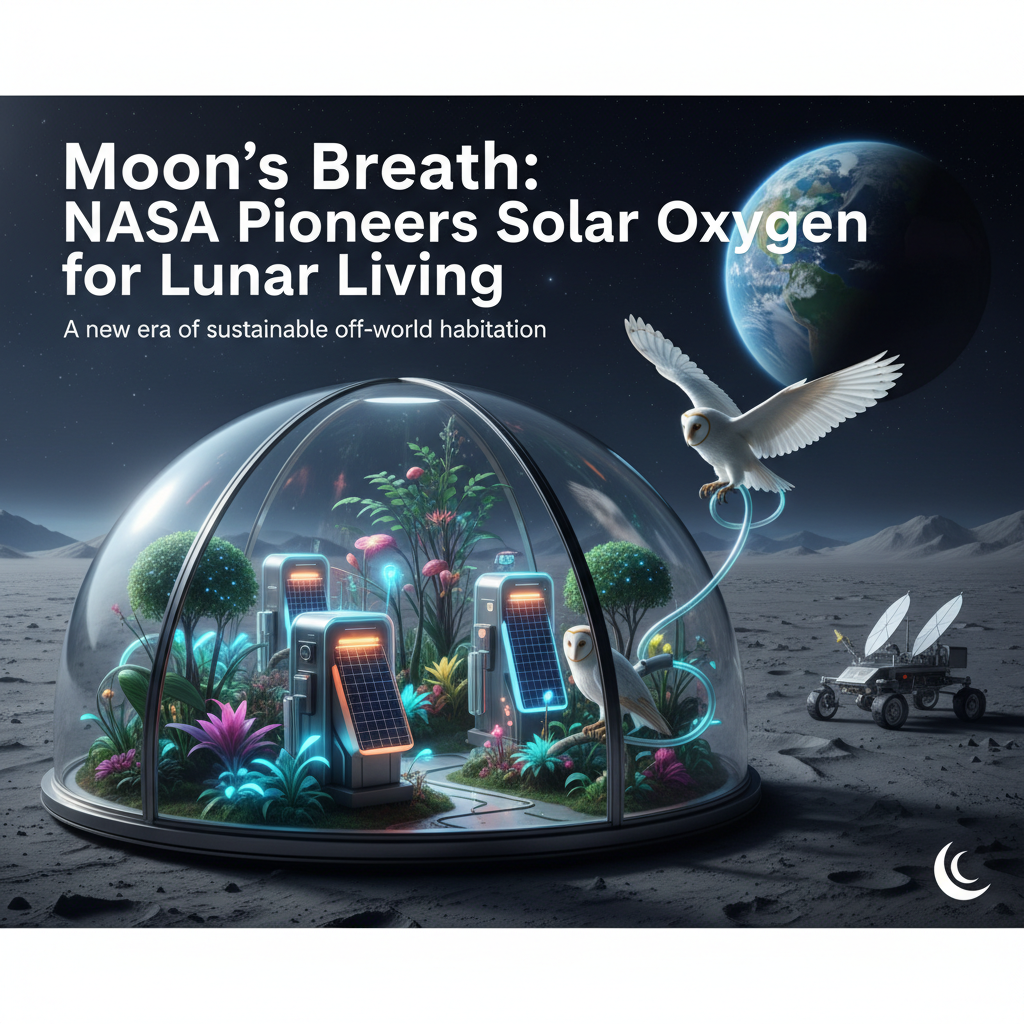
Key Takeaways
- NASA's CaRD project focuses on solar-powered oxygen extraction on the Moon.
- It uses concentrated sunlight to process lunar regolith (moon dust).
- Goal: provide oxygen for astronaut life support and rocket fuel.
- This advances sustainable living principles (ISRU) for space and Earth.
- Project signifies a step towards an enduring human presence on the Moon.
As humanity looks to the stars, the challenge of sustainable living extends beyond Earth's borders. A groundbreaking NASA project is demonstrating how ingenuity and renewable energy could provide the very air astronauts breathe on the Moon, offering vital lessons for our planet's future.
TL;DR: Key Facts
- NASA's Carbothermal Reduction Demonstration (CaRD) project is developing technology to extract oxygen on the Moon.
- It utilizes solar concentrators to heat simulated lunar regolith (moon dust).
- The goal is to produce oxygen for astronaut life support and rocket fuel at the Moon's south pole.
- A recent test successfully integrated the solar concentrator, proving the concept's viability.
- This initiative is crucial for establishing a sustainable, enduring human presence beyond Earth.
What Happened
NASA's Carbothermal Reduction Demonstration (CaRD) project recently achieved a significant milestone, testing a solar concentrator designed to extract oxygen from lunar soil. This innovative effort, captured in a recent photo from August 7, 2025, highlights the agency’s commitment to advancing its capabilities for sustainable off-world exploration. The concentrator, which efficiently channels and intensifies sunlight, was successfully integrated as a crucial component of the larger CaRD system. This system is specifically engineered to process simulated lunar regolith, the fine, loose material covering the Moon's surface, with the explicit aim of generating oxygen, particularly at the Moon’s strategically important south pole.
The core of this groundbreaking process is carbothermal reduction, a method that involves heating the lunar regolith to extremely high temperatures. This intense heat is generated using the concentrated solar energy gathered by the concentrator. Through this reaction, oxygen compounds inherently present within the lunar soil are released. These liberated oxygen molecules can then be captured, purified, and stored. The primary and vital objective of developing and implementing this technology is to provide a reliable and sustainable source of oxygen for future lunar missions. This isn't just about breathing; the extracted oxygen serves dual, critical purposes: supporting astronaut life systems, ensuring their survival and well-being, and potentially acting as a key component for rocket propellant. By producing these essential resources directly on the Moon, NASA drastically reduces the logistical complexity, cost, and payload mass associated with transporting such vital supplies from Earth, making a long-term, enduring human presence more feasible and sustainable.
Why It Matters
While this news story originates from the cutting edge of space exploration and scientific discovery, its implications for sustainable living here on Earth, and our understanding of responsible resource management, are profoundly significant for GreenNest Living readers. The CaRD project stands as a powerful testament to the principles of in-situ resource utilization (ISRU) – a philosophy that advocates for 'living off the land,' even when that 'land' is as alien and challenging as the Moon. By actively seeking and developing methods to produce fundamental necessities like oxygen directly from local extraterrestrial materials, and by powering this process with an abundant renewable energy source like solar, NASA is, in essence, crafting a pioneering blueprint for extreme self-sufficiency. This endeavor directly mirrors the global imperative we face on Earth: to drastically reduce our dependence on finite resources, minimize our environmental footprint, and move towards more circular economies.
For our GreenNest Living community, this isn't merely an abstract concept about astronauts breathing on the Moon; it's a tangible demonstration of pushing the very boundaries of what is achievable with renewable energy technologies and innovative circular resource models. The sun-powered oxygen extraction method brilliantly showcases how concentrated solar technology can be effectively leveraged for highly energy-intensive industrial processes, even when operating under the most unforgiving environmental conditions. This revolutionary approach holds immense potential to inspire and catalyze terrestrial applications. Imagine cleaner, more energy-efficient industrial processes on Earth, more effective resource recovery from complex waste streams, or the development of truly self-sustaining living systems in remote, challenging, or disaster-stricken environments. Furthermore, this project implicitly underscores a universal truth relevant to both space and Earth: true sustainability isn't merely a desirable choice; it is an absolute and fundamental prerequisite for any enduring presence, whether in an off-world outpost or within the delicate ecosystems of our own planet. It powerfully illustrates that addressing complex environmental challenges often requires bold, forward-thinking, and technologically advanced solutions. The lessons learned and the technologies developed from striving for sustainability in space can directly inform and accelerate our terrestrial efforts to protect our wildlife, conserve natural habitats, and minimize humanity's overall impact on Earth's precious natural environment.
What You Can Do
- Investigate Renewable Energy: Research solar energy solutions for your home or community. Look into solar panels, solar water heaters, or community solar projects to reduce your carbon footprint.
- Support ISRU Principles: Advocate for policies that promote resource efficiency, comprehensive recycling programs, and circular economy models in your local area, mirroring the 'living off the land' approach demonstrated by NASA.
- Reduce, Reuse, Recycle: Embrace these core principles rigorously in your daily life to minimize waste generation, conserve valuable resources, and lessen the demand for new materials.
- Educate Yourself & Others: Continuously learn more about sustainable practices, green technologies, and environmental challenges. Share this knowledge within your network, as understanding innovative solutions can inspire practical changes on Earth.
- Conserve Energy: Adopt diligent energy-saving habits at home, such as unplugging electronics when not in use, utilizing energy-efficient LED lighting, and optimizing your heating and cooling systems to reduce your personal demand on energy resources.
- Advocate for Green Tech: Support the research, development, and adoption of green technologies that offer sustainable alternatives to current resource-intensive and environmentally impactful processes.
FAQs
Q: What is lunar regolith?
A: Lunar regolith is the layer of loose, rocky material that covers the solid rock on the Moon's surface, often referred to as moon dust. It's a key resource for in-situ utilization.
Q: Why is the Moon's south pole significant for this project?
A: The Moon's south pole is believed to contain significant reserves of water ice in permanently shadowed craters. This makes it a prime location for establishing a sustainable base, as both water and oxygen are crucial for human missions.
Q: How does this relate to environmental efforts on Earth?
A: The project demonstrates advanced methods for resource extraction and utilization using renewable energy. It offers insights and technologies that can be adapted for more sustainable industrial processes, waste management, and resource conservation on Earth, promoting a circular economy.
Sources
This article is based on reporting by NASA Breaking News.
Original source
NASA Breaking News
Author, Digital Entrepreneur & AI Creator
More from Wildlife & Nature News
- The Silent Drain: Sand Scarcity Threatens Global Ecosystems — May 13, 2026
- Celestial Glimpse: Earth's Glow, Our Lost Night Skies — May 11, 2026
- Google's UK Datacentre Emissions Understated by Factor of Five — May 10, 2026
- Cosmic Beacon: Earth's Glow Inspires Global Stewardship — May 9, 2026
- Amazon Tipping Point: Deforestation, Warming Threaten Rainforest by 2040s — May 8, 2026