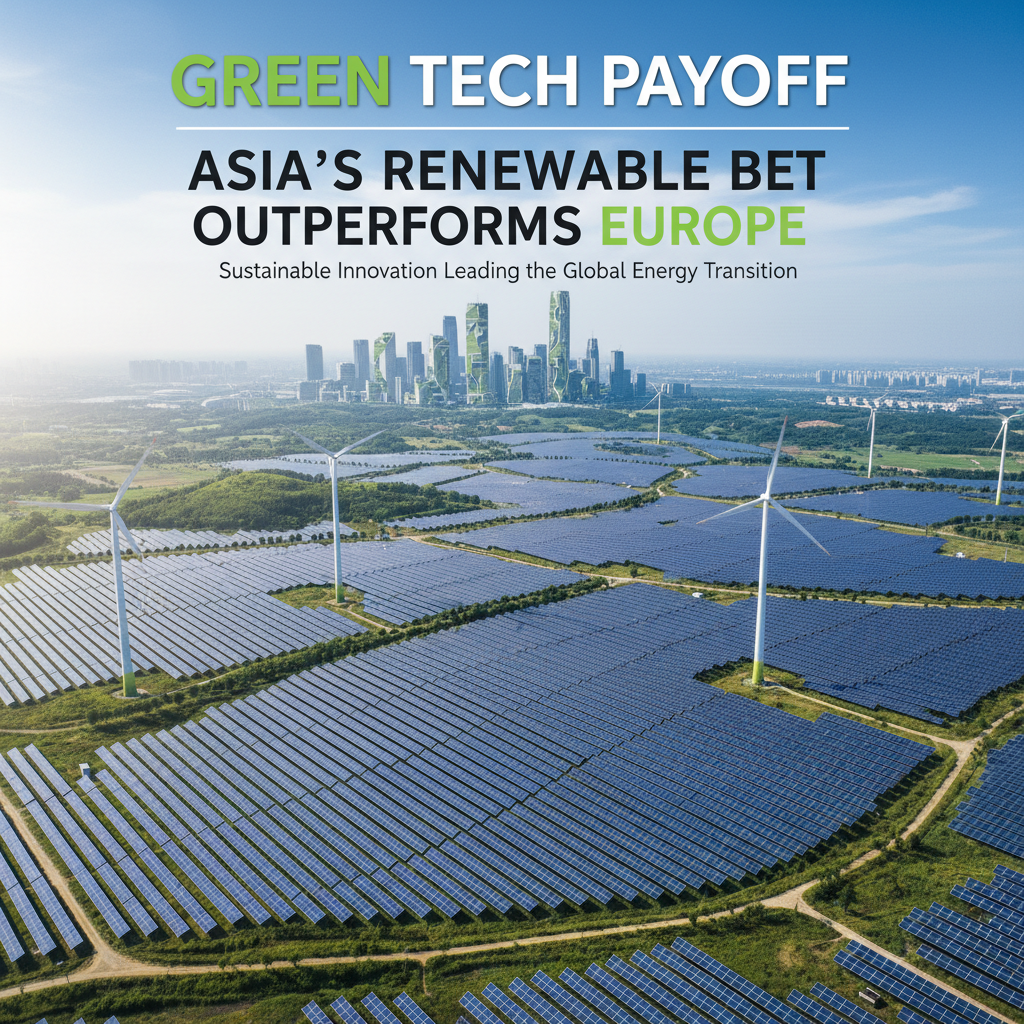
Green Tech Payoff: Asia's Renewable Bet Outperforms Europe
Key Takeaways
- Europe doubled down on fossil fuels in 2022.
- India and China heavily invested in renewable energy.
- Renewable energy investments are directly linked to national resilience during fuel crises.
- Strategic energy choices have profound economic and geopolitical consequences.
- Green Tech offers a pathway to energy independence and stability.
In an era defined by unprecedented climate challenges and volatile global markets, the ongoing fuel crisis serves as a stark, undeniable reminder of our energy vulnerabilities. This crisis has also illuminated a critical strategic divergence in global energy policy, revealing which nations have truly invested in a sustainable future and which are still tethered to the past.
New analysis suggests that countries which prioritized renewable energy development are now far more resilient to economic shocks, pointing fingers at Europe's continued fossil fuel reliance compared to the rapid green strides made by economic giants like India and China.
TL;DR: Key Facts
- In 2022, Europe reportedly doubled down on investments in fossil fuels, amidst energy security concerns.
- Concurrently, major economies like India and China significantly ramped up their investments in renewable energy infrastructure.
- Experts contend that nations who invested in renewables are now better equipped to withstand the current global fuel crisis.
- This policy divergence highlights the profound economic and geopolitical benefits of a rapid transition to green technologies.
What Happened
According to recent expert analysis featured by Euronews Green, a critical strategic misstep occurred in 2022: Europe reportedly chose to heavily invest in fossil fuels, ostensibly to shore up its energy security in the face of geopolitical instability and supply chain disruptions. This decision, driven by immediate concerns, contrasts sharply with the long-term vision embraced by other global players.
During the same period, countries such as India and China made substantial and sustained investments in renewable energy sources like solar and wind power, alongside necessary infrastructure. Their commitment reflected a proactive strategy to decarbonize their economies while simultaneously enhancing energy independence and stability.
The consequence of these divergent paths is now becoming clear: experts argue that those nations which poured resources into renewables are proving far more resilient in the face of the current global fuel crisis. They are better insulated from price volatility and supply chain shocks, demonstrating that green investments are not just an environmental imperative but a powerful economic hedge against instability.
Why It Matters
This news transcends mere geopolitical commentary; it serves as a powerful, real-world validation of Green Tech's indispensable role in modern society. Renewable energy technologies—from vast solar farms and towering wind turbines to advanced energy storage solutions and intelligent smart grids—are no longer merely aspirational environmental projects. They have unequivocally emerged as crucial economic and geopolitical assets. The current energy crisis, exacerbated by global instability, brutally exposes the inherent vulnerability of fossil fuel dependence and champions the resilience and stability offered by diversified, often locally sourced, green energy solutions. For GreenNest Living readers, this report reinforces the argument that Green Tech is not just a ‘nice-to-have’ for environmental stewardship but a fundamental ‘must-have’ for national security, economic stability, and societal well-being.
Beyond immediate crisis mitigation, the embrace of Green Tech fundamentally shifts traditional power dynamics. Nations that strategically invest in and adopt these technologies reduce their reliance on volatile global energy markets and fossil fuel-producing states, thereby enhancing their sovereignty and negotiating power. This transition also fosters domestic innovation, creates new industries and high-skill jobs, and promises long-term price stability for consumers and businesses alike. For our readers, understanding this macro-level shift underscores that individual and community-level actions in supporting green energy initiatives contribute to this broader national and global resilience, making every choice to adopt sustainable living practices part of a larger, impactful movement.
Ultimately, the comparison between Europe's approach and that of India and China serves as both a stark warning and a clear signal for future investment strategies across the globe. It highlights that delaying the inevitable transition to green technologies incurs significant and escalating economic, social, and environmental costs. Conversely, proactive investment in Green Tech represents not just an ethical and environmentally responsible choice, but an increasingly financially prudent one for governments, industries, and even individual households looking for long-term savings, stability, and a healthier planet. It's a testament to the fact that green living isn't just about personal choice; it's about robust, forward-thinking policy.
What You Can Do
- Advocate for Green Policies: Support local and national policies that prioritize investment in renewable energy infrastructure, incentivize green tech adoption, and phase out fossil fuel subsidies.
- Adopt Home Renewables: Explore options for installing solar panels on your home or participating in community solar programs to reduce your reliance on grid energy.
- Enhance Energy Efficiency: Upgrade to energy-efficient appliances, improve home insulation, and adopt smart home technologies to minimize energy consumption.
- Educate and Inspire: Share information about the economic and environmental benefits of green tech with your friends, family, and community to build broader support.
- Reduce Your Carbon Footprint: Make conscious choices to reduce personal energy consumption by choosing public transport, cycling, or walking, and opting for sustainable products.
- Support Green Businesses: Patronize companies that demonstrate a strong commitment to renewable energy, sustainable supply chains, and transparent environmental practices.
FAQs
Q: What constitutes "Green Tech" in this context?
A: In this context, "Green Tech" primarily refers to technologies related to renewable energy sources like solar, wind, and hydro power, as well as energy storage solutions (e.g., batteries), smart grid systems, and energy efficiency innovations designed to reduce reliance on fossil fuels.
Q: Why is Europe described as having "learned the wrong lesson"?
A: Experts suggest Europe's continued emphasis on fossil fuel investments and reliance in 2022 left it more vulnerable to global energy price spikes, supply chain disruptions, and geopolitical pressures compared to nations that rapidly scaled up their renewable energy capacity.
Q: How does investing in renewables make a country more resilient?
A: Investing in renewables diversifies a country's energy sources, reduces its dependence on imported fossil fuels from volatile markets, stabilizes energy costs over the long term, and often fosters domestic energy production and technological innovation, thereby making the economy less susceptible to external energy shocks.
Sources
This article is based on reporting by Euronews Green.
Original source
Euronews Green
Author, Digital Entrepreneur & AI Creator
More from Green Tech
- UK Electric Buses Transform into Grid Powerhouses with V2G — May 13, 2026
- Ocean-Powered AI: Panthalassa's Bold Vision for Sustainable Compute — May 12, 2026
- Winnipeg Powers Up: 250 EV Chargers Accelerate Sustainable Living — May 11, 2026
- Philippines' Wind Power Dream Hinges on Port Infrastructure — May 10, 2026
- Aviation's Carbon Blind Spot: Ryanair's Soaring Emissions Exposed — May 9, 2026