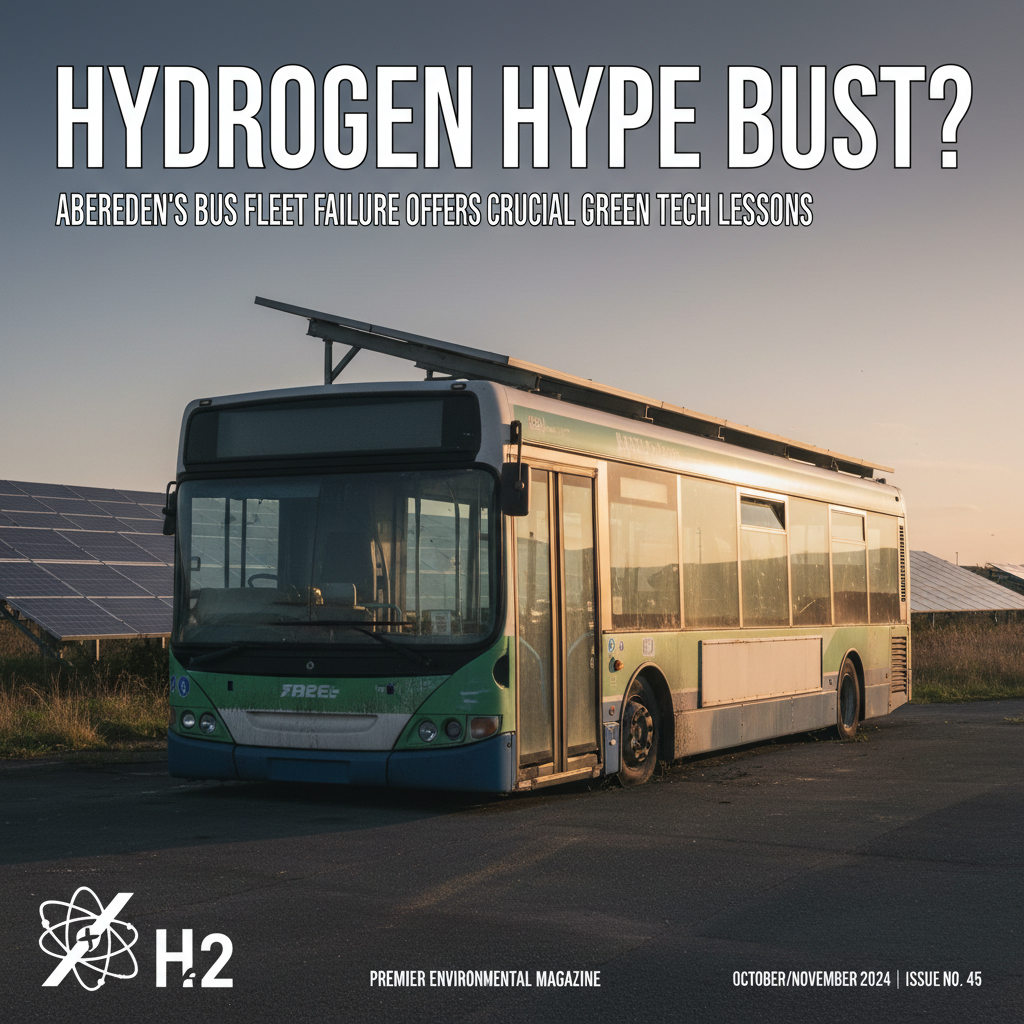
Hydrogen Hype Bust? Aberdeen's Bus Fleet Failure Offers Crucial Green Tech Lessons
Key Takeaways
- Aberdeen retired its 25 hydrogen double-decker buses, marking the end of a flagship project.
- The fleet was once promoted as the world's first hydrogen double-deck operation and a cornerstone of the city's green ambitions.
- The initiative aimed to establish Aberdeen as a leader in hydrogen transport and a broader hydrogen economy.
- The decision highlights significant challenges in the practical implementation and economic viability of early-stage hydrogen transport.
- The buses are now up for sale, closing a high-profile chapter on a green initiative that failed to meet expectations.
The promise of a hydrogen-powered future often gleams brightly, but sometimes, reality bites. News from Aberdeen, Scotland, delivers a stark reminder that even the most ambitious green initiatives face formidable hurdles. The decision to retire and sell the city's pioneering hydrogen bus fleet, once a global beacon of clean transport, sends ripples across the sustainable living landscape, urging us to learn from its demise.
TL;DR: Key Facts
- Aberdeen has retired its entire fleet of 25 hydrogen double-decker buses, putting them up for sale.
- This fleet was previously celebrated as the world's first hydrogen double-deck operation and a cornerstone of Aberdeen's clean transport ambitions.
- The initiative was meant to establish Aberdeen as a leader in a broader hydrogen economy.
- The project's termination underscores significant operational, economic, and infrastructure challenges in implementing early-stage hydrogen public transport.
- The city's move marks a critical turning point for hydrogen advocates, prompting a re-evaluation of deployment strategies for nascent green technologies.
What Happened
In a significant development for the future of green public transport, the city of Aberdeen has announced the retirement and planned sale of its 25 hydrogen double-decker buses. This fleet, which began operations with considerable fanfare, was once touted as the world’s first hydrogen double-deck bus service, positioning Aberdeen at the forefront of clean transportation innovation. The ambitious project was launched with the vision of creating a foundational element for a broader hydrogen economy within the city and beyond, aiming to reduce emissions and demonstrate the viability of hydrogen as a fuel source for heavy-duty vehicles.
The journey began with confident claims about Aberdeen’s global leadership in clean transport, inspiring hopes for a scalable and sustainable alternative to fossil fuel-powered public transit. However, this chapter has now closed, with the city deciding to discontinue the operation and liquidate the assets. This move directly contradicts the initial optimistic outlook, signaling a substantial pivot away from the hydrogen bus project that had garnered international attention and significant investment.
The decision to retire the fleet effectively puts an end to a high-profile experiment in green technology adoption. While specific reasons for the failure are not explicitly detailed in the CleanTechnica report, the outcome strongly suggests that the practical implementation, operational costs, or infrastructure support for the hydrogen buses did not meet expectations or prove sustainable in the long term. The buses are now available for purchase, symbolizing the conclusion of what was once a beacon of clean energy innovation.
Why It Matters
For GreenNest Living readers, this news from Aberdeen isn't just a local bus story; it's a profound lesson in the realities of green technology deployment. The failure of such a high-profile hydrogen project serves as a crucial case study, illustrating that the path to a sustainable future is rarely linear and often fraught with unforeseen complexities. It underscores the vital importance of moving beyond initial enthusiasm to rigorously evaluate the entire ecosystem required for a new green technology to thrive – from robust infrastructure and reliable supply chains to long-term economic viability and practical operational challenges.
This incident highlights that not all green solutions are created equal, nor are they equally ready for widespread adoption. While hydrogen holds immense promise as a clean energy carrier, especially for heavy transport where battery-electric solutions face weight and range limitations, Aberdeen's experience suggests that its market readiness, particularly for public transport fleets, might still be maturing. It forces us to ask critical questions about the true 'greenness' of hydrogen production (e.g., green hydrogen vs. grey/blue), the energy efficiency of its full lifecycle, and the prohibitive costs associated with developing new refueling infrastructure compared to more established electric charging networks.
Ultimately, this story urges us to adopt a pragmatic and informed approach to sustainable living and green investments. It’s a call to scrutinize the entire value chain of emerging technologies and to understand that environmental benefits must be weighed against practical implementation hurdles, economic sustainability, and scalability. It's a reminder that true green innovation isn't just about inventing new technologies, but about making them durable, affordable, and genuinely sustainable in the real world.
What You Can Do
- Investigate Local Initiatives: Research green transport projects in your own city or region. Understand their funding, technology, and long-term sustainability plans.
- Support Proven Technologies: While innovation is crucial, prioritize advocating for and adopting green technologies that have demonstrated reliability and cost-effectiveness, such as electric vehicles (EVs) and improved public transit.
- Demand Transparency: When new green projects are announced, encourage local authorities and project developers to provide transparent reporting on costs, performance metrics, and environmental impacts.
- Learn About Green Hydrogen: Educate yourself on the differences between 'green' (produced from renewables), 'blue' (from fossil fuels with carbon capture), and 'grey' hydrogen. Support only truly sustainable production methods.
- Advocate for Integrated Planning: Push for holistic urban planning that considers infrastructure, energy sources, and end-user needs when implementing new sustainable transport solutions.
- Consider Lifecycle Costs: When evaluating green technologies, think beyond initial purchase price to include maintenance, fuel/energy costs, infrastructure, and eventual disposal or recycling.
FAQs
Q: What is hydrogen fuel cell technology?
A: Hydrogen fuel cell technology generates electricity by combining hydrogen and oxygen, producing only water vapor as a byproduct. This electricity then powers an electric motor, similar to a battery electric vehicle, but without needing to be plugged in to recharge a large battery from the grid.
Q: Why did Aberdeen's hydrogen bus fleet fail?
A: While the CleanTechnica report doesn't detail specific reasons, the termination of such a project often points to a combination of factors including high operational costs, challenges with hydrogen fuel supply and infrastructure, maintenance complexities, or overall economic unsustainability compared to alternative transport solutions.
Q: Does this mean hydrogen isn't a viable green energy solution?
A: Not necessarily. Aberdeen's experience highlights the challenges of early adoption and scaling, particularly in niche applications like urban bus fleets. Hydrogen still holds significant promise for other sectors, such as heavy-duty long-haul transport, industrial processes, and energy storage, especially as green hydrogen production and infrastructure mature and become more cost-effective.
Sources
This article is based on reporting by CleanTechnica.
Original source
CleanTechnica
Author, Digital Entrepreneur & AI Creator
More from Green Tech
- UK Electric Buses Transform into Grid Powerhouses with V2G — May 13, 2026
- Ocean-Powered AI: Panthalassa's Bold Vision for Sustainable Compute — May 12, 2026
- Winnipeg Powers Up: 250 EV Chargers Accelerate Sustainable Living — May 11, 2026
- Philippines' Wind Power Dream Hinges on Port Infrastructure — May 10, 2026
- Aviation's Carbon Blind Spot: Ryanair's Soaring Emissions Exposed — May 9, 2026