Space Solar: Unlimited Clean Energy Beyond Net Zero?
Key Takeaways
- Space-based solar is now a viable green energy technology.
- It promises to help move beyond net-zero emissions targets.
- Could transform the renewable energy sector with continuous power.
- Once seen as sci-fi, it's becoming practical due to tech advancements.
- Offers a solution to the intermittency of Earth-bound renewables.
OPENING PARAGRAPH
As the global climate crisis demands increasingly innovative solutions, the conversation often centers on terrestrial renewables. Yet, a vision once confined to science fiction is rapidly becoming a tangible reality, promising not just to meet our energy needs, but to transcend them entirely. Imagine a future where clean power flows limitlessly, harvested directly from orbit, perpetually available regardless of weather or time of day.
TL;DR: Key Facts
- Space-based solar power (SBSP) is now considered a viable technology for generating clean energy.
- It has the potential to help humanity move beyond current net-zero emissions targets.
- SBSP could transform the entire renewable energy sector by providing continuous, uninterrupted power.
- The concept, once seen as a 'dystopian fantasy,' is moving closer to practical application thanks to technological advancements.
What Happened
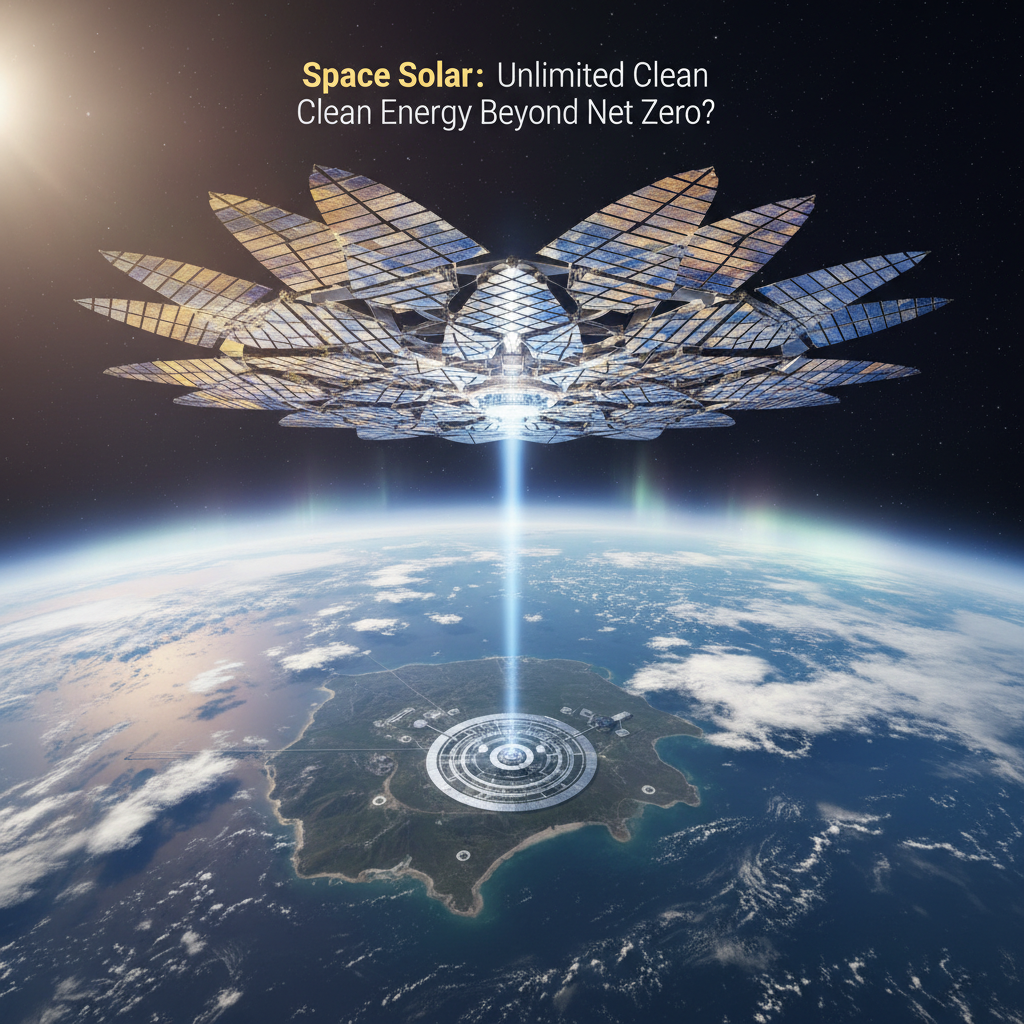
The idea of harvesting solar energy from space has long captivated scientists and futurists, promising an inexhaustible supply of clean power. Unlike Earth-bound solar panels, which are constrained by night cycles, variable weather conditions, and atmospheric absorption, orbiting satellites can capture the sun’s energy almost continuously and with significantly greater intensity. This energy, once converted to electrical power in space, would then be wirelessly transmitted back to receiving stations on Earth, typically via highly focused microwave or laser beams, efficiently converting light into usable electricity.
Historically, the ambitious engineering challenges associated with space-based solar power (SBSP) — particularly the immense cost of launching massive components, the complexity of assembling structures in orbit, and the efficiency of power transmission over vast distances — relegated it to the realm of theoretical possibility or even dismissed it as a 'dystopian fantasy.' However, the landscape has dramatically shifted. Breakthroughs in aerospace technology, including the advent of reusable rockets and declining launch costs, are making orbital deployment more economically feasible. Concurrently, advancements in lightweight composite materials, miniaturized electronics, and precision wireless power transmission systems are paving the way for modular, scalable SBSP designs. These technological leaps are transforming SBSP from a distant dream into a serious contender for a sustainable energy future, with various nations and private enterprises now actively investing in research and prototype development.
Why It Matters
For GreenNest Living readers and indeed, for anyone concerned about our planet's future, space-based solar power represents arguably the most transformative 'Green Tech' innovation on the horizon. Current terrestrial renewable energy sources, while absolutely vital, face inherent limitations. Solar panels cease functioning at night or under heavy cloud cover, and wind turbines require consistent breezes – leading to an intermittency problem that necessitates expensive and complex energy storage solutions and sophisticated grid management. This challenge is one of the primary hurdles in achieving a fully decarbonized energy system.
SBSP fundamentally solves this intermittency issue. Orbiting above the atmosphere, it can operate 24/7, year-round, delivering a truly continuous, baseload power source. This 'clean power everywhere' potential could dramatically accelerate global decarbonization efforts, allowing nations not just to meet their net-zero targets but to realistically push 'beyond net zero' by providing an abundant supply of green electricity for hard-to-decarbonize sectors like heavy industry or even for large-scale carbon capture technologies. Moreover, SBSP promises unparalleled energy security and independence, reducing reliance on geographically concentrated fossil fuel resources and offering a stable power supply to remote or developing regions. Beyond its environmental benefits, the pursuit of SBSP would unleash an explosion of innovation across high-tech sectors – from advanced materials and robotics to space engineering and artificial intelligence – generating new green jobs, fostering international collaboration, and driving economic growth, thus reshaping the very foundation of our global energy infrastructure for centuries to come.
What You Can Do
- Stay Informed: Follow developments in space-based solar power and other cutting-edge green technologies. Knowledge is power for advocacy.
- Advocate for Green Tech Funding: Support policies and elected officials who champion investment in advanced renewable energy research and development, including space-based solutions.
- Support STEM Education: Encourage the next generation to pursue careers in science, technology, engineering, and mathematics, which are crucial for developing these complex systems.
- Reduce Your Energy Footprint: While waiting for large-scale solutions, continue to reduce personal energy consumption and invest in home energy efficiency. Every watt saved is a step towards a sustainable future.
- Invest Ethically (where applicable): Explore opportunities to support companies or funds focused on sustainable technologies and space innovation, contributing to the financial momentum of green tech.
- Share the Vision: Discuss the potential of technologies like space-based solar with friends, family, and community members to build public understanding and support for a high-tech green future.
FAQs
Q: How does space-based solar power actually work?
A: Satellites in Earth's orbit collect sunlight using large solar arrays, much like terrestrial panels but without atmospheric interference. This collected energy is then converted into microwaves or laser beams and safely transmitted wirelessly down to receiving antennas (rectennas) on Earth, where it's converted back into electricity for the grid.
Q: Is beaming energy from space safe for people and the environment?
A: Safety is a paramount concern for researchers. Current proposals involve using non-ionizing radiation (like microwaves) at frequencies designed to be harmless to humans and wildlife. The beams would be diffused over large areas and monitored to prevent concentration, ensuring they meet strict safety standards.
Q: What are the biggest challenges to making space-based solar a reality?
A: Key challenges include the high cost of launching materials into space, the development of very large and lightweight orbital structures, efficient and safe wireless power transmission over long distances, and the political and regulatory frameworks needed for such a global endeavor. However, ongoing technological advancements are steadily addressing these hurdles.
Sources
This article is based on reporting by Euronews Green.
Original source
Euronews Green
Author, Digital Entrepreneur & AI Creator
More from Green Tech
- UK Electric Buses Transform into Grid Powerhouses with V2G — May 13, 2026
- Ocean-Powered AI: Panthalassa's Bold Vision for Sustainable Compute — May 12, 2026
- Winnipeg Powers Up: 250 EV Chargers Accelerate Sustainable Living — May 11, 2026
- Philippines' Wind Power Dream Hinges on Port Infrastructure — May 10, 2026
- Aviation's Carbon Blind Spot: Ryanair's Soaring Emissions Exposed — May 9, 2026